

Filtering Out Microplastics
Microplastics in drinking water
Microplastics are everywhere. They are found in our food, the air, even in our drinking water. Recent studies have shown that 93% of bottled water and 83% of tap water contain microplastics. Unfortunately the United States was found to have disproportionately high rates of microplastics in tap water, at a rate of 94%. So how did they get there? When plastic encounters heat, UV rays, or erosion, it breaks down into smaller and smaller pieces until they are classified as microplastics. Some of these pieces are so small that they are unable to be filtered out of our drinking water by municipal water treatment facilities, leading to the presence of microplastics in our drinking water. Is there any way we can ensure that our tap water is free from microplastics before drinking it? Here is some information on water filters that will help reduce the amount of microplastics in our drinking water.
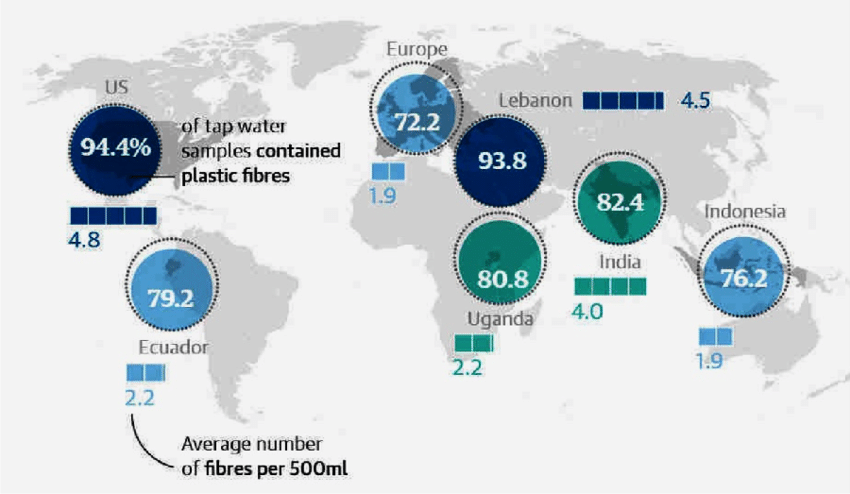
Image Credit: Orb Media
What are microplastics
Microplastics are fragmented pieces of plastic measuring less than 5 mm in length. Nanoplastics are even smaller, measuring less than 100 nm in length. Early studies have shown that microplastics can be harmful to human cells, but there has not been enough long-term research to learn just how negatively these tiny pieces of plastic can impact our health.
types of water filters
There are several different methods we use to filter our water. Each method has the ability to filter out microplastics, but some are more effective than others. Unfortunately, only one of these methods is able to filter out nanoplastics.
-
Granular activated carbon is made from organic materials that are high in carbon. This material is heated to increase the surface area, which allows the carbon to trap more impurities. Carbon particles in this type of filter range from 0.8 to 1.0 mm in diameter. This leaves pore spaces that are small enough to trap some microplastics. The issue with GAC filters is that over time the carbon powder can form channels, leaving more pore space and reducing the amount of microplastics that are removed from the water.
-
Powdered activated carbon is made from the same material as granulated activated carbon, but is much smaller. Powdered activated carbon particles are smaller than .18 mm in diameter and used in Carbon Block Filters. This method filters out more microplastics, but takes longer to do so. Powdered activated carbon is also only able to be used one time, whereas granular activated carbon can be reactivated and reused under certain conditions. Both types of carbon filters are able to filter out microplastics, but are less effective than other options.
-
Ceramic filters are made from a ceramic material with pore spaces that are approximately 0.5 mm in diameter. Ceramic filters have been in use since the 1800’s and will filter out dirt, bacteria, and other impurities. Most ceramic filters today use granular activated carbon as well, which helps to remove chlorine and other substances that the ceramic will not remove on its own.
-
Microfiltration uses a membrane to filter impurities from water. The membranes used in microfiltration have pore spaces that are 0.1 to 10 micrometers in diameter. They are effective at filtering out algae, bacteria, protozoa, and debris like larger pieces of microplastics.
-
Like microfiltration, ultrafiltration also uses membranes to filter impurities. Unlike microfiltration, ultrafiltration has much smaller pores, ranging from 0.001 to 0.1 micrometer in diameter. This method is much more effective when it comes to filtering microplastics from tap water.
-
Nanofiltration also uses semipermeable membranes to filter impurities from water. Membranes used in nanofiltration have pore spaces ranging from 0.002 to 0.005 micrometers in diameter. This method will filter out microplastics and even some nanoplastics.
-
Reverse osmosis is the most effective type of filtration. It also uses semipermeable membranes, but has the smallest pore spaces of all other methods. The small pore spaces used in reverse osmosis will filter out any particles that are 0.0001 micrometers or larger. This means it will filter out microplastics and nanoplastics from drinking water.

Image Credit: waterpurificationguide.com
NSF Certification
The National Sanitation Foundation is a non-profit organization founded in 1944 specializing in public health. They test and audit products to make sure they are up to public health standards and certify the product once they are found to be up to national standards. There are several kinds of NSF certifications, ranging from NSF Standard 42 to NSF Standard P231. A certification of NSF Standard 42 covers aesthetic properties of water, such as smell and taste, while a certification of NSF Standard 58 covers contaminants that can be removed by reverse osmosis. For more information on the different types of certifications, visit this website.
Here is a list of some well known water filter brands that are NSF certified:
Remember when choosing a water filter from this list that you research the specific filter. Chances are these companies manufacture more than one type of filter and different types of filters may have different certifications, or no certifications at all.
Choosing the Right Water Filter
There are several different factors that one must consider when choosing a water filter. You will want to consider the style of filter, one that attaches to your faucet or a free-standing pitcher. You will also want to consider the amount of drinking water that your household will go through. A smaller pitcher in a larger household will run through water filters rather quickly. Another factor to consider is the quality of water in your household. Are there other things, like lead or chlorine, that you would like to filter as well? These factors and many others should be taken into consideration before choosing a water filter system for your household.
Make sure to research your water filter before purchasing to make sure it covers all of your household’s needs. If an NSF certification is something that is important to you, use this tool to look up a filter you may be interested in purchasing. You can search by water filter brand, by NSF certification type, manufacturer, or product type to find out if it meets the standards you are looking for in a water filtration system. This is also a great way to verify a claim by a manufacturer that their water filters have been NSF certified.
There are many water filters that are not NSF certified. This does not mean that they do not filter out the items they claim, it just means they have not been evaluated by the National Sanitation Foundation.